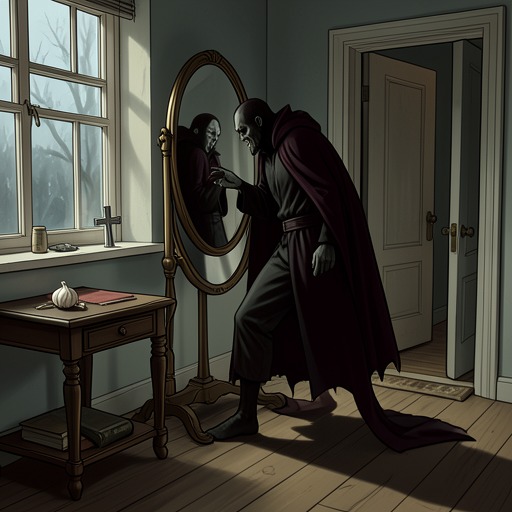
vampire garlic rule
A History of the Vampire in Popular CultureThe vampire garlic rule is the convention that garlic can deter, repel, or otherwise protect against a vampire. Its decisive significance lies less in any stable supernatural mechanism than in the way it converts a familiar food into a defensive boundary between the living and the blood-drinking dead. The rule belongs to a wider family of vampire safeguards, alongside crucifixes, communion wafers, stakes, and other protective or killing instruments, but garlic is distinctive because it can be consumed as an ordinary part of domestic life while carrying the symbolic force of purification.
Definition and Folkloric Logic
Garlic has long been regarded as a purifier of the blood and is still widely eaten for its supposed health benefits. From that premise, the rule develops a simple analogy: if vampires are impure because they feed on blood, garlic should make a person an unattractive or dangerous target. The defensive act need not be elaborate. Eating garlic, adding more of it to a meal, or keeping it close at hand turns everyday nourishment into a protective ritual.
The rule is therefore a form of sympathetic logic rather than a consistently demonstrated physical law. Blood is treated as the site of life and contamination at once, while garlic is assigned the opposite status: a substance capable of cleansing what the vampire corrupts. The contrast gives the convention its intuitive power. A vampire approaches through the intimate sphere of the household, often at night and while victims sleep; garlic answers that intrusion with an object already associated with bodily health and domestic control.
Disease, Symptoms, and Misrecognition
The apparent plausibility of the garlic rule has also been reinforced by medical history. Porphyria affects the skin and nervous system and can, in some cases, produce symptoms that appear vampiric: extreme sensitivity to sunlight, blistering and burning skin, nighttime activity, psychosis, and red urine. Some forms of porphyria also make sufferers unusually sensitive to foods with high sulphur content, including garlic. In this medical circumstance, garlic could aggravate a condition rather than repel an external monster.
Porphyria has occasionally been offered as an explanation for vampire stories, and a craving for human blood has been compared with pica, the compulsion to consume substances with no nutritional value. An iron deficiency might make blood seem attractive because blood contains iron, even if the person experiencing the craving did not understand its cause. Yet the connection is too weak to account for the many historical accusations of vampirism. The vampiric effects of porphyria are rare, and their supposed explanatory power has been largely debunked. The garlic rule consequently illustrates a broader process in which genuine symptoms, partial medical knowledge, and supernatural interpretation become fused into folklore.
The Rule Among Other Protections
The garlic convention operates beside the vampire reflection rule and the vampire crucifix rule, but the book stresses that these rules vary sharply across versions of the legend. A mirror may be used to test whether a suspected vampire has a reflection; garlic may be added to dinner for reassurance; and a crucifix may be waved at an attacker. Yet the efficacy of the cross depends on two conditions: the vampire must know that it is supposed to fear the object, and the myth must be sufficiently believed for that fear to operate. Garlic belongs to the same unstable system. Its power is not guaranteed by a universal vampire biology but by the story’s agreement that garlic counts as an antidote.
Religious protections make the contrast especially clear. Crucifixes function as metaphors of divine life confronting an entity associated with darkness and moral impurity. In nineteenth-century England, the authors of The Vampyre and Dracula were middle-class white men shaped by a Christian social environment, so Christian symbolism naturally influenced both the vampire and the objects capable of threatening it. Garlic is less explicitly theological, but it performs a related act of classification: it marks the vampire as polluted and the protected household as capable of cleansing itself.
Historical Fear and Cultural Transmission
The persistence of such rules reflects the circumstances in which vampire explanations became persuasive. The nineteenth century was marked by rapid technological and social change, spiritualism, and a continuing readiness to treat witchcraft and other supernatural claims as factual. During the vampire panic in New England, tuberculosis was often understood as the dead returning to drain the life force of surviving relatives. In Exeter, Rhode Island, the deaths of Mary Brown, Mary Olive Brown, and Mercy Brown were followed by the exhumation of the family’s bodies; Mercy’s heart and lungs were removed and burned, and the ashes were mixed with water and given to Edwin Brown as a failed medicinal concoction.
Earlier European vampire panics show the same search for a controllable defensive procedure. During the eighteenth-century vampire craze, villages dug up suspect corpses and staked them. In 1731, after thirteen deaths in a Serbian village, residents rejected a doctor’s explanation of malnutrition and insisted that vampires were responsible. Johann Flückinger and other witnesses later reported bodies that had not greatly decomposed and appeared plump, with apparent blood in their mouths. Such episodes demonstrate how physical evidence could be reorganized by fear into a system of supernatural diagnosis and countermeasure. Garlic belongs to this same cultural machinery: it offers a visible, repeatable action when disease and death seem otherwise unintelligible.
The rule survives because repetition makes fiction resemble fact. Accounts are altered as they move through memory, folklore, newspapers, novels, films, and television, with personal beliefs and social backgrounds laid over the material at every stage. The Gorbals Vampire episode shows how media can enlarge a local fear into a public campaign: the Daily Mirror blamed imported horror comics for children’s hysteria and discussed banning them, while officials argued that such publications were harmful even though they did not fit the existing legal definition of obscenity. Garlic, like the comic-book vampire itself, becomes powerful through circulation, recognition, and collective expectation.
Variations and Narrative Meaning
The rule is not universal even within vampire fiction. In the BBC adaptation of Dracula, the vampire’s rules are treated as objects of investigation rather than unquestioned facts. Sister Agatha Van Helsing describes vampirism as a contagion that removes the holy ability to die and presents herself to Dracula as an intelligent woman armed with a crucifix. Her approach exposes the larger logic behind protective traditions: the hunter tests the supposed laws of the monster, while the monster’s identity is partly produced by the expectations surrounding those laws.
Other traditions complicate the neatness of garlic as a universal remedy. In the Sefer Hasidim story of Astryiah, an elderly female vampire who sucks blood through her hair, the stated antidote to an estrie’s bite is to eat the creature’s bread and salt, not garlic. The same collection describes a method for stopping an estrie in the grave by hammering a spike through her mouth into the earth and filling her mouth with stones. These details place garlic within a shifting repertoire of substances and actions that answer different forms of supernatural contamination.
The vampire garlic rule therefore works simultaneously as practical advice within a story, a symbol of purity, and evidence of cultural change. It gives audiences a reassuringly concrete response to an invisible threat, but its very variability reveals that vampire weaknesses are assembled by religion, medicine, local custom, literature, and media. Garlic does not merely repel the vampire; it helps define what the vampire is supposed to be: a blood-feeding, impure outsider whose power can be challenged by an ordinary substance invested with communal belief.